Research & Planning Datasets
Consultants, planners, and grant writers need credible activity data on a schedule and a budget. Waypoint generates continuous, image-validated observational datasets — no manual counts, no field crews.
Questions We Answer
How do we get defensible usage data for this study?
Can we support a grant application with real numbers?
How do we validate a capital project's impact?
How do we measure usage without staffing field crews?
What variables can we actually measure?
How does this compare to surveys and counters?
What You Get
Study-ready datasets
Continuous, exportable observational data for reports and applications.
Defensible & auditable
Image-validated counts reviewers and boards can trust.
Deploy on your timeline
Temporary or permanent deployments stood up in hours.
Before/after measurement
Quantify the impact of investments and capital projects.
Research Applications
Observational Datasets Without Field Staff
Much planning and research still rests on observational data collected over a handful of days, constrained by labor availability, budget, and the practical difficulty of covering multiple locations at once. Those constraints quietly shape the findings — short windows miss seasonal variation, and thin coverage misses the sites that matter most. Waypoint enables the collection of large observational datasets over extended periods, automating capture while preserving image-based validation, so researchers and planners can build datasets that would otherwise be cost-prohibitive.
These datasets support:
- Master plans
- Feasibility studies
- Grant applications
- Environmental review
- Academic and transportation research
- Recreation planning
The result is image-validated data rich enough to anchor a master plan, a grant application, or a feasibility study — not just illustrate it.
Why Researchers and Consultants Choose Waypoint
Traditional methods each force a trade-off: manual observation is accurate but expensive and short; intercept surveys add detail but carry small samples and self-selection bias; infrared counters run continuously but can't tell you what happened or validate it. Waypoint combines the strengths — continuous collection periods, richer classified datasets, lower labor cost, and image validation behind every observation — so a study's conclusions rest on evidence a reviewer or board can audit.
Compared to traditional methods, Waypoint offers:
- Richer, classified datasets
- Longer collection periods
- Lower labor costs
- Image validation of every observation
Variables That Can Be Measured
Depending on the deployment and site, a single Waypoint station can capture a wide set of observational variables from the same imagery — the raw material for cross-tabulated analysis rather than a single headline count.
Commonly measured variables:
- Counts
- Activity type
- Directionality
- Time of day
- Day of week
- Seasonal trends
- Facility occupancy
- User-behavior indicators
Metrics We Capture
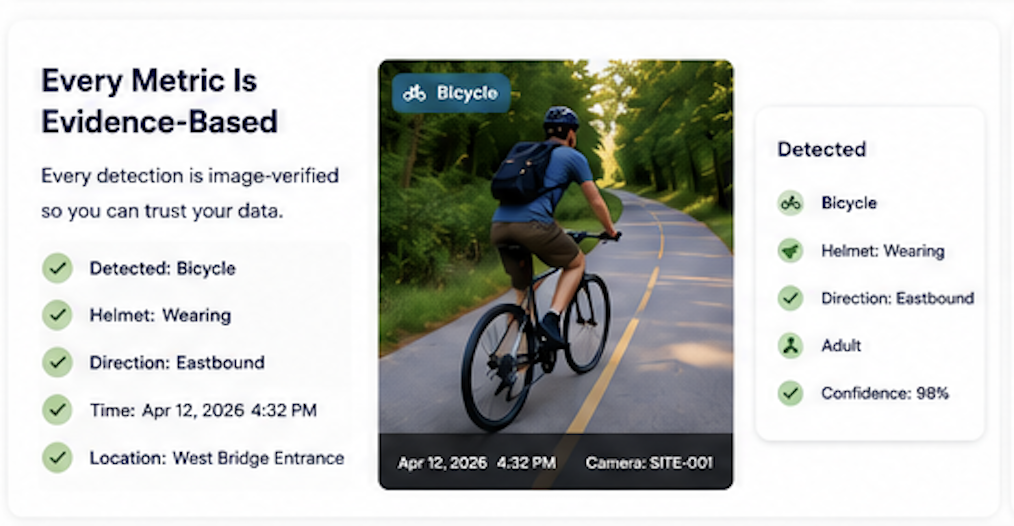
Every metric below is derived from image-validated detections — exportable and auditable, not modeled estimates.
Traditional Methods vs. Waypoint
How observational methods compare for recreation and active-transportation research.
| Method | Trade-off |
|---|---|
| Manual observation | Accurate, but expensive and limited to short windows. |
| Intercept surveys | Rich detail, but small sample sizes and self-selection bias. |
| Infrared counters | Continuous, but no activity, direction, or validation. |
| Parking counts | Easy proxy, but only an indirect estimate of visitation. |
| Waypoint | Continuous, classified, directional, and image-validated. |
What the Data Looks Like
Every metric is evidence-based — each detection is image-verified and auditable.