Trailhead Demand & Congestion Analytics
Trailheads are where demand concentrates and conflicts surface. Measure how full each access point gets, when it fills, and which trailheads actually drive your system's usage.
Questions We Answer
Which trailheads are busiest?
When do they fill up?
Which access points drive the most usage?
Where should we add parking or capacity?
Are visitors redistributing after improvements?
How should wayfinding direct visitors?
What You Get
Peak fill times
Identify exactly when each trailhead reaches capacity, by day and hour.
Access-point comparison
Rank trailheads by demand to prioritize capital and capacity investments.
Arrival patterns
Understand visitor inflow and turnover throughout the day.
Defensible capacity data
Evidence to support parking, restroom, and infrastructure decisions.
Planning & Operations Applications
Access Point Performance
Trail usage doesn't begin on the trail — it begins at the trailhead, where parking availability, amenities, wayfinding, and location shape how and where visitors enter the system. Monitoring trailhead activity and the parking demand around it reveals which access points serve as the primary gateways, how arrivals distribute across the day, and how visitors spread themselves across a network.
Compare across access points:
- Trailhead popularity and ranking
- Arrival and turnover patterns
- Parking demand by location
- User distribution across the network
That performance picture is valuable for both day-to-day operations and the long-range investment decisions that follow — which access points to expand, which to promote, and which to relieve.
Managing Growth & Congestion
As trail systems grow more popular, trailheads are usually the first place capacity breaks down. Parking shortages, congestion, and overcrowding degrade the visitor experience and create real operational headaches for staff — and they tend to concentrate into specific times and specific access points. Objective data on when and where those conditions occur lets agencies respond with evidence rather than anecdote.
Identify:
- Overflow and spillover conditions
- Capacity limitations by access point
- Peak demand windows
- Access inequities across the network
This data supports:
- Additional parking decisions
- Congestion mitigation
- Wayfinding and signage
- New-trailhead siting
- Restroom and amenity siting
Connecting Access Demand to Trail Usage
Because the same platform can watch both the lot and the trail, you can link parking occupancy directly to downstream activity — something a standalone counter or parking sensor can't do. That connection turns a parking count into a leading indicator of trail demand, and shows how access timing shapes the peaks on the trail itself.
Relationships you can quantify:
- Parking occupancy vs. trail volume
- Arrival timing vs. peak trail use
- Turnover and dwell at the trailhead
- Network-wide demand distribution
Metrics We Capture
Every metric below is derived from image-validated detections — exportable and auditable, not modeled estimates.
What the Data Looks Like
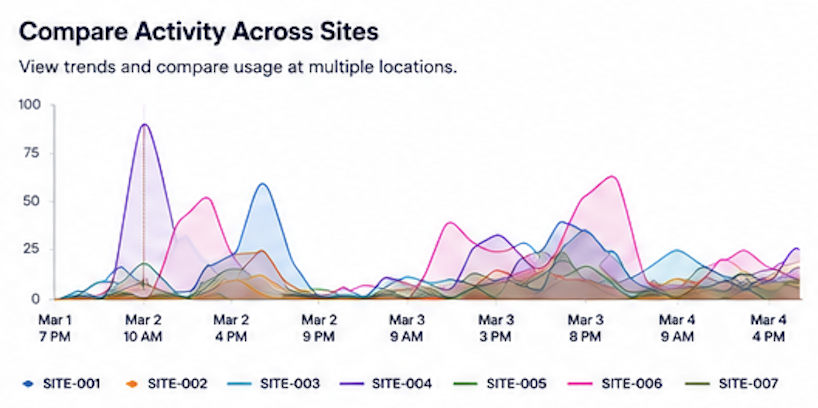
Compare activity across access points to see which trailheads drive usage.