
VisionAI One
The Outdoor Camera Built for Analytics
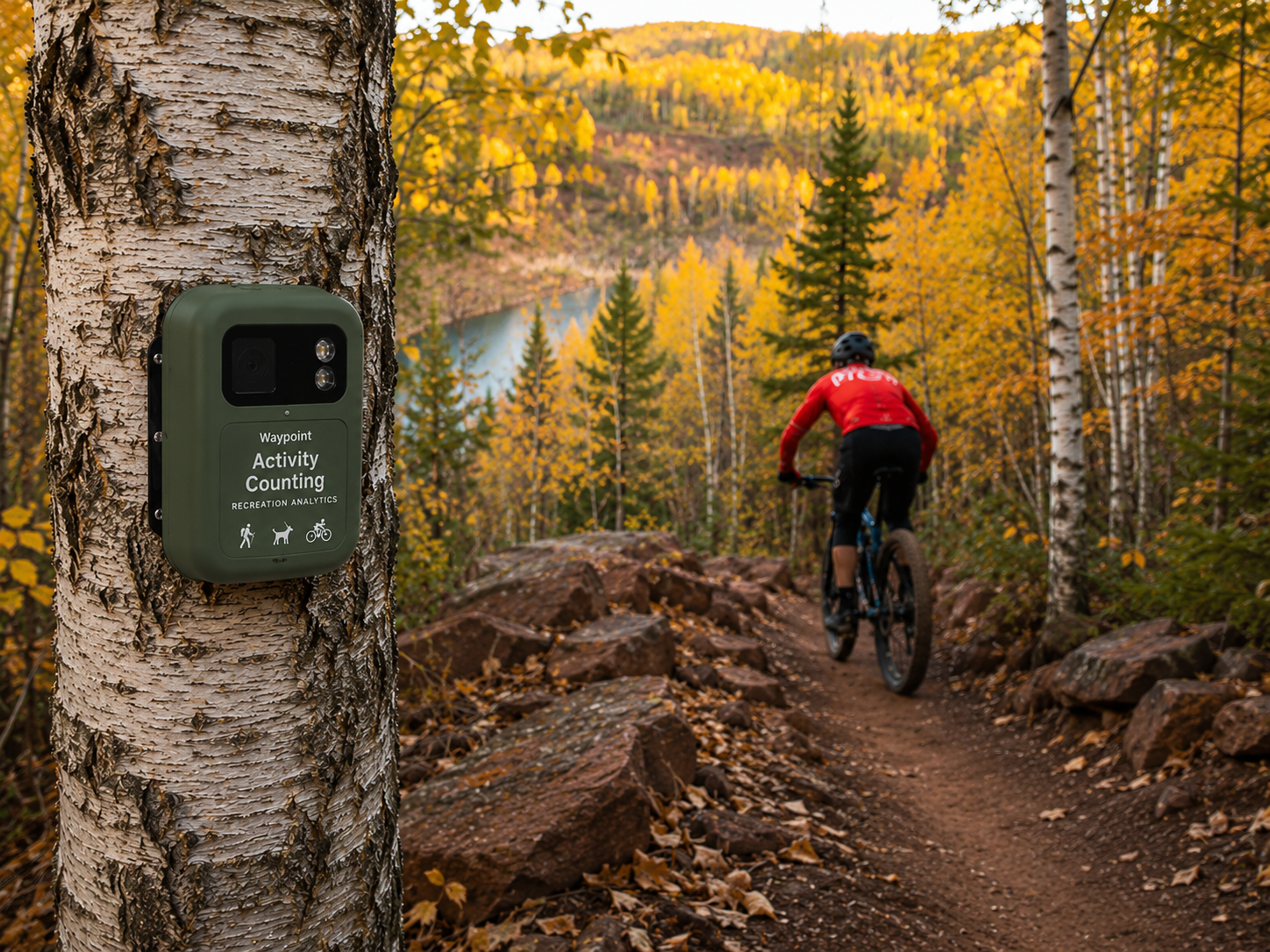
VisionAI One is a cellular, solar-capable outdoor monitoring camera that helps parks, agencies, researchers, and recreation organizations understand how people use trails, parks, courts, parking areas, and other outdoor spaces.
What It Is
Vision-based analytics for outdoor spaces
VisionAI One is a purpose-built outdoor monitoring camera from Waypoint Telemetry. It captures event-based observations of activity — people, bikes, dogs, vehicles — and delivers them over cellular to Waypoint Cloud, where computer vision turns them into activity counts and utilization analytics.
Waypoint Telemetry builds vision-based analytics for outdoor recreation and public spaces. Where a traditional trail counter produces a number, VisionAI One provides the context and evidence behind the number: what the activity was, which direction it moved, when it peaked, and how a space was actually used.
At a Glance
- Cellular connectivity — no Wi-Fi required
- Battery powered, solar-capable
- Event-based still imagery, not video
- Weather-resistant outdoor enclosure
- Mounts to trees, posts, poles, or fences
- Remote data delivery and device management
- Analytics via Waypoint's cloud platform
What It Measures
One camera. More ways to understand outdoor use.
VisionAI One supports two complementary kinds of measurement — counting the activity that passes a location, and measuring how a space or asset is used over time.
Activity Counting
Count passages. Classify the activity.
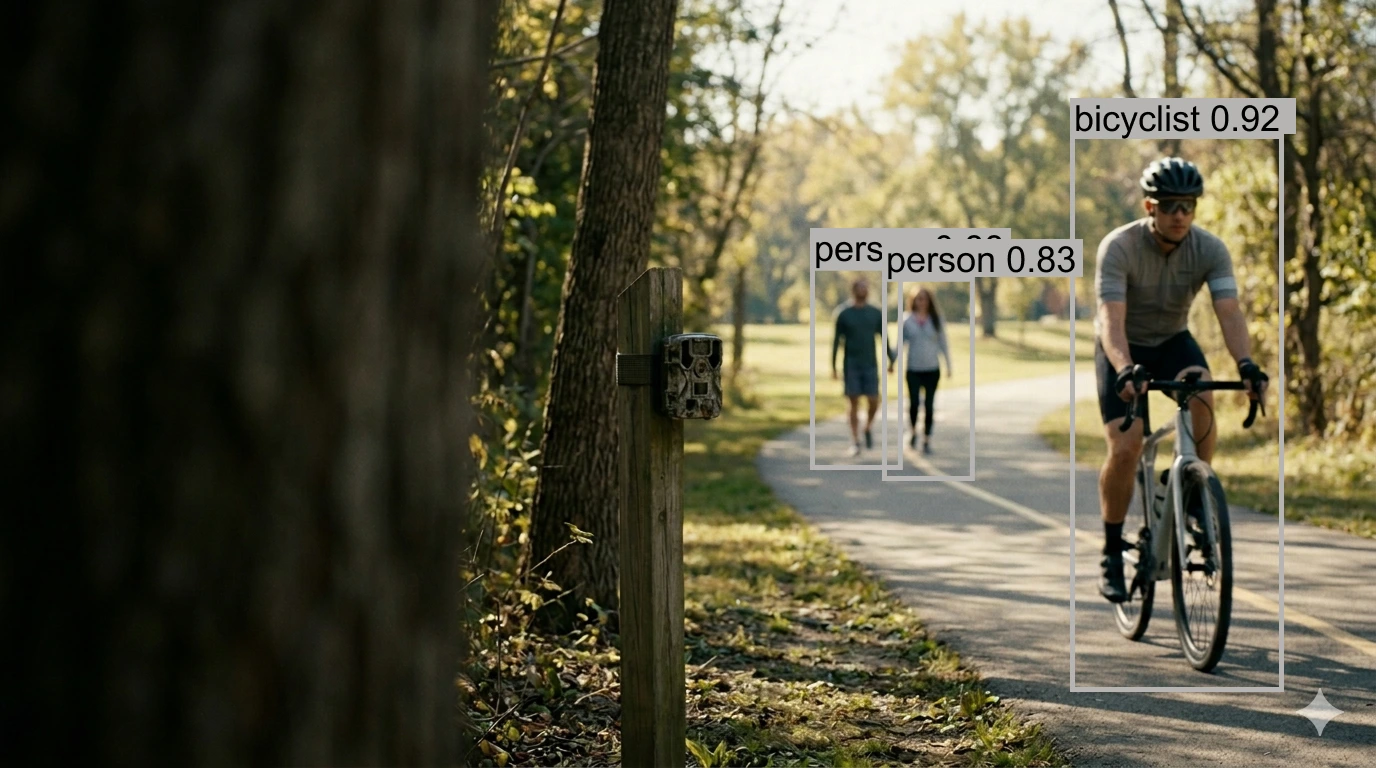
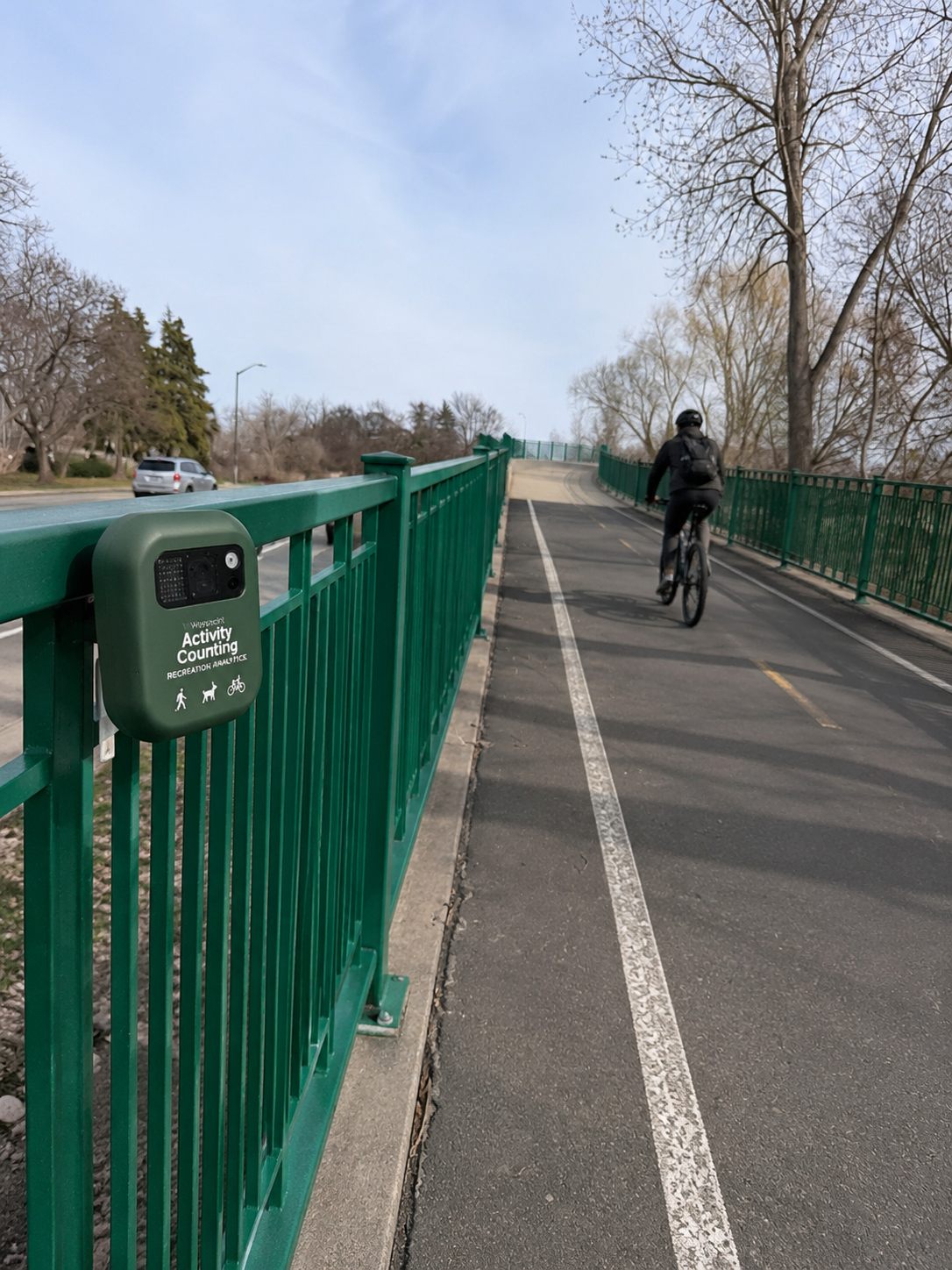
Count trail and corridor traffic while classifying activity types, measuring direction of travel, and revealing time-of-day and seasonal patterns — a richer alternative to traditional trail counters, with visual evidence behind the data.
Utilization Analytics
Measure how spaces are actually used.
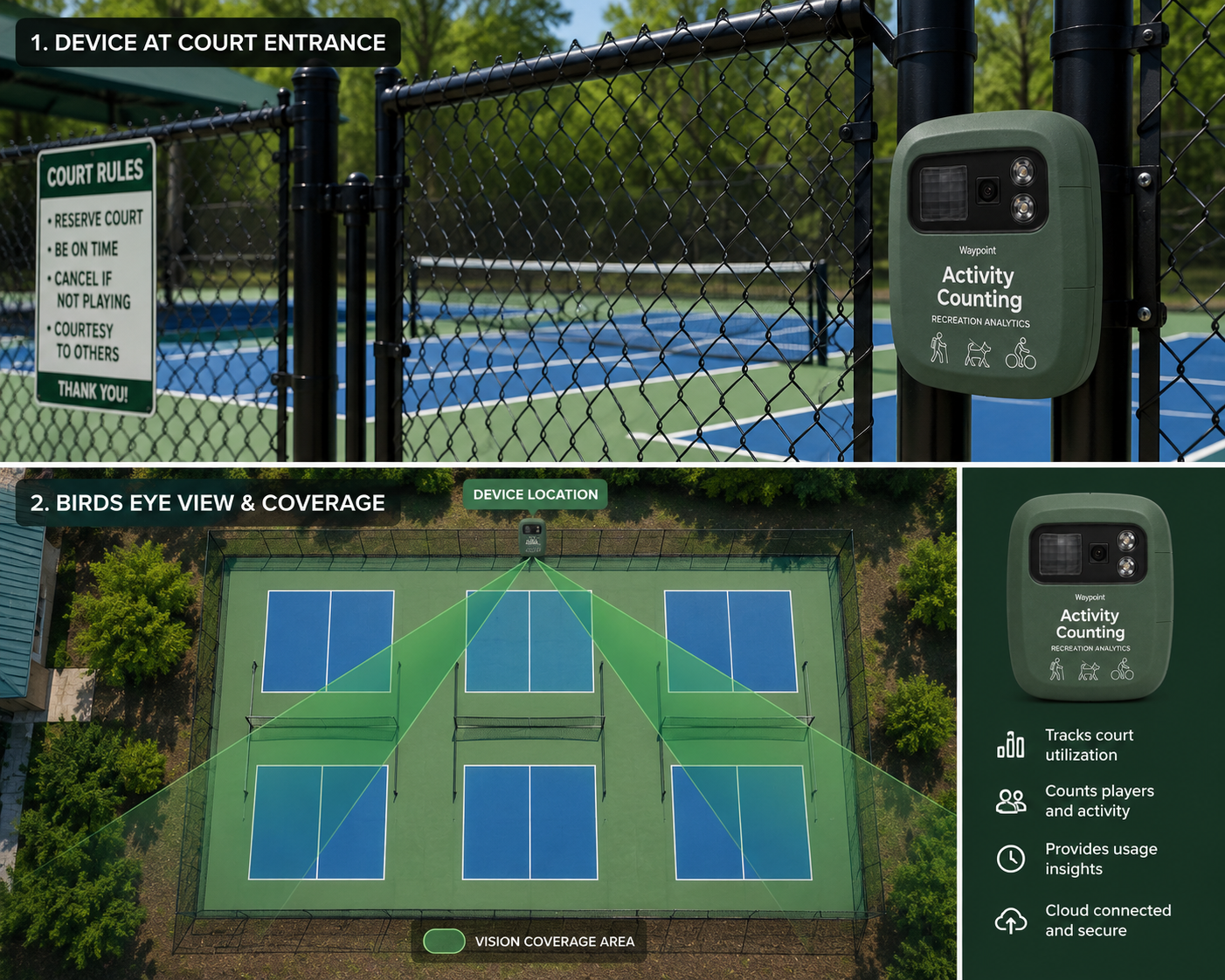
Measure when courts, parking areas, and recreation assets are occupied, how long they are used, and how utilization changes across days and seasons — answering capacity and investment questions that counters cannot.
How It Works
From observation to understanding in four steps
Observe
VisionAI One captures event-based observations of activity in its field of view — still images, not continuous video.
Connect
The cellular camera sends observations to Waypoint Cloud automatically. No local Wi-Fi, wiring, or site visits required.
Analyze
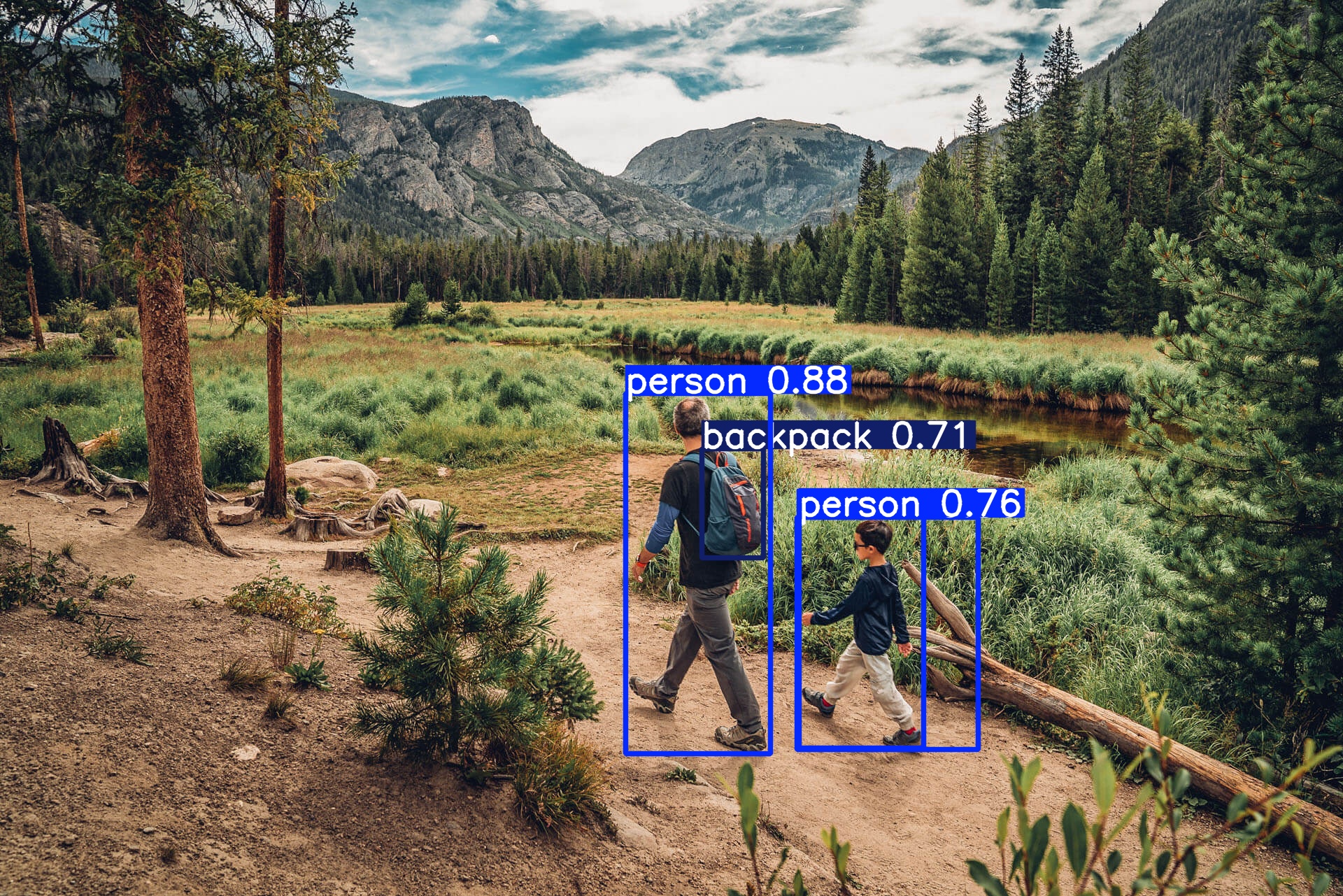
Waypoint's computer vision converts imagery into structured data: counts, activity classes, direction, and utilization.
Understand
Results appear in the Waypoint dashboard as trends, charts, comparisons, and validation imagery you can act on.
Read more about the full deployment process on the How Waypoint Works page.
What You Can Learn
Answers, not just numbers
Every deployment is configured around the questions you need answered. Depending on application and configuration, VisionAI One can provide:
Field Hardware
Built for the places you're trying to measure
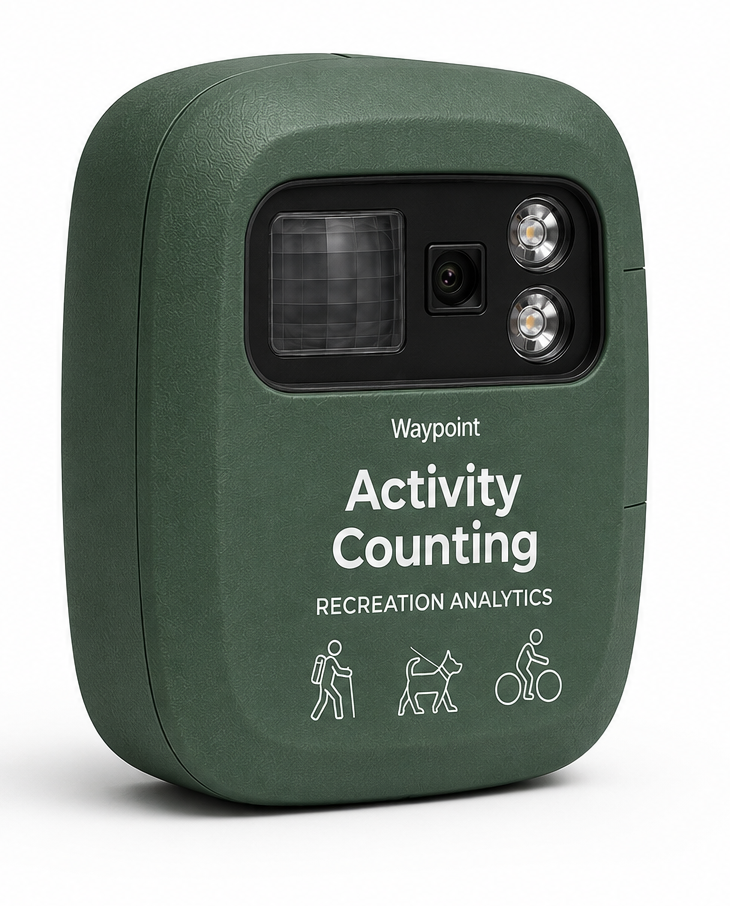
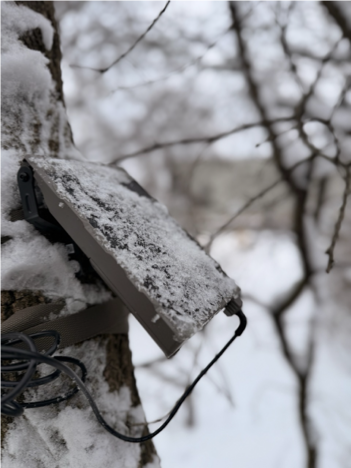
Trails, courts, riversides, and trailheads rarely have power, network infrastructure, or staff nearby. VisionAI One was designed for exactly those places: it runs on battery with external solar, connects over cellular, and installs in minutes without trenching or permanent construction.
Cellular
Connects over cellular networks — no local Wi-Fi or wired network required.
Solar-capable
Battery powered, with external solar for long-duration remote deployments.
Remote
Data is delivered automatically, and devices can be managed remotely — minimizing routine field visits.
Outdoor
Weather-resistant enclosure and wide-angle vision purpose-built for outdoor environments.
Flexible
One hardware platform across trails, parks, courts, parking, and other outdoor applications.
Easy to deploy
Mounts to trees, posts, poles, or fences in minutes — no trenching or permanent infrastructure.
The Complete System
From camera to decision
VisionAI One is not a standalone camera — it's the field component of a complete measurement system. The hardware collects observations; Waypoint Cloud turns them into analytics you can plan, budget, and report with.
VisionAI One
Event-based observations
Cellular Connection
Automatic remote delivery
Waypoint Computer Vision
Detection & classification
Waypoint Cloud
Storage & analytics
Actionable Analytics
Dashboards & exports
Applications
One platform, many outdoor spaces
The same hardware and analytics platform adapts to the location and the questions being asked. Capabilities vary by application — emerging use cases are scoped during deployment planning.
Trails & Greenways
Understand traffic volumes, activity mix, direction of travel, and long-term trends.
Parks & Recreation Areas
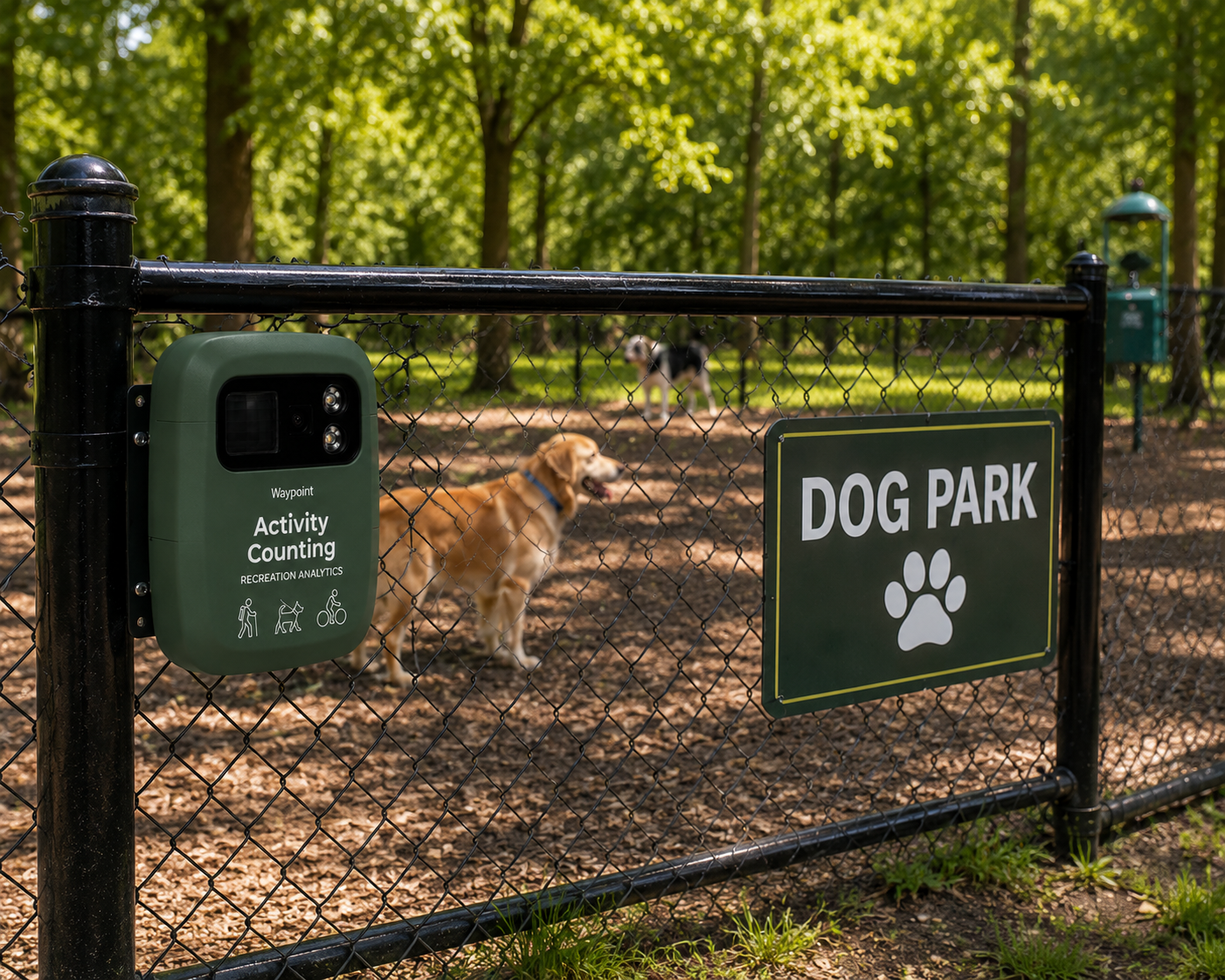
Measure visitation and understand how public outdoor spaces are actually used.
Bike Parks & Cycling
Understand rider volumes, patterns, and how trail segments are utilized.
Pickleball & Tennis
Measure court utilization and peak demand without manual observation studies.
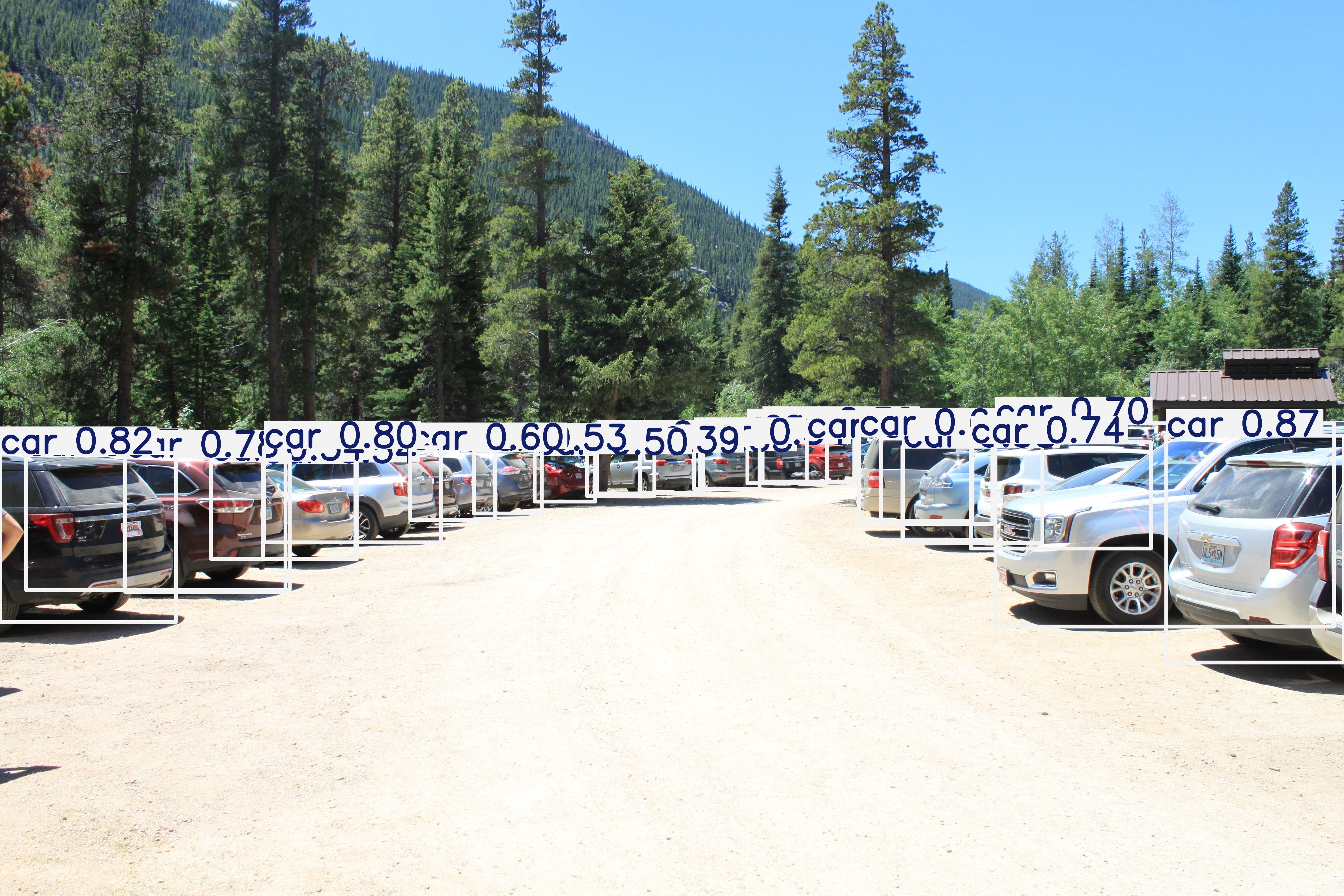
Trailheads & Parking
Understand arrivals, occupancy, and usage patterns at access points.
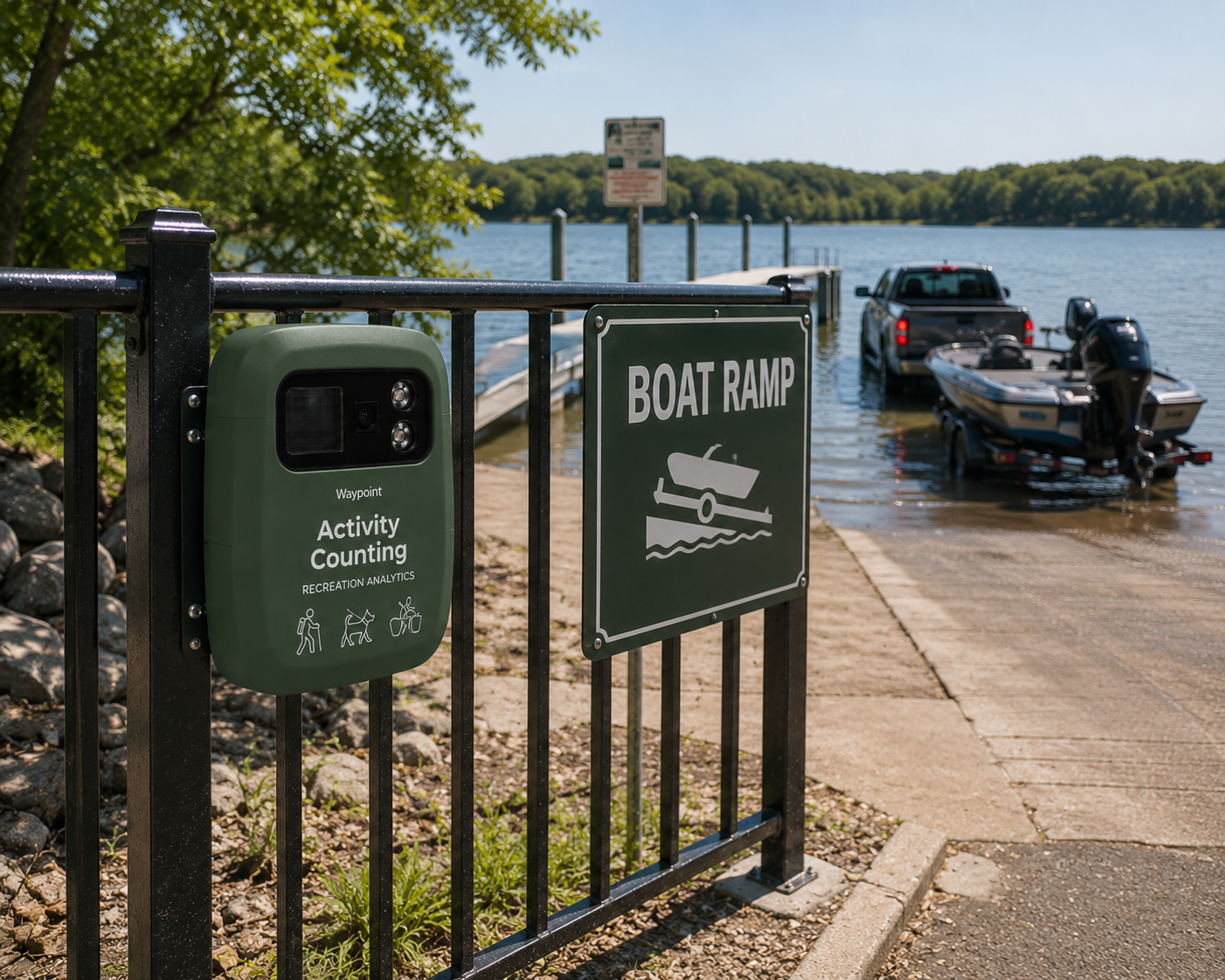
Rivers & Waterways
Measure supported recreation activity in places that are difficult to observe manually.
Why Vision
Go beyond the count
Infrared and pneumatic counters do one job well: registering that something passed. Vision-based measurement answers the questions that follow — who, which way, when, and what it means for your space.
| Dimension | Traditional Counter | VisionAI One |
|---|---|---|
| What is measured | Trigger events, reported as a number | Visual observations of people, bikes, dogs, and vehicles |
| Activity types | Usually limited or not distinguished | Classified from imagery — pedestrian, cyclist, dog, vehicle, and more |
| Direction of travel | Often unavailable or inferred | Measured from visual observations |
| Validation | Difficult to audit after the fact | Representative imagery available for review where enabled |
| Applications | Typically purpose-specific | Counting and utilization analytics on one platform |
| Data retrieval | Varies — some systems require site visits | Cellular delivery, no routine site visits |
For a deeper technical comparison, see vision vs. infrared counters and our review of trail counter accuracy research. Replacing or expanding a TRAFx program? See our TRAFx alternative comparison.
Defensible Analytics
Data you can explain — not just a number you have to trust
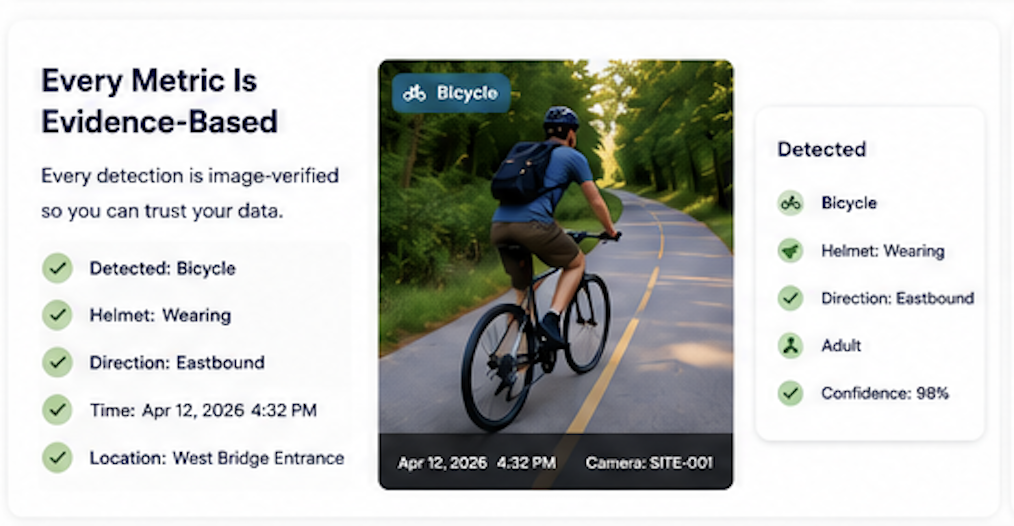
When a sensor count is questioned, there is usually no way to check it after the fact. Vision-based measurement is different: because analytics are derived from imagery, authorized users can review representative source imagery behind observations and results where enabled.
That auditability matters when the data supports planning decisions, grant reporting, capital investment, before-and-after studies, research, and public presentations — anywhere a stakeholder might reasonably ask, "how do you know?"
See how Waypoint validates its measurements in the noise-filtering validation study and live deployments like Hyland Lake.
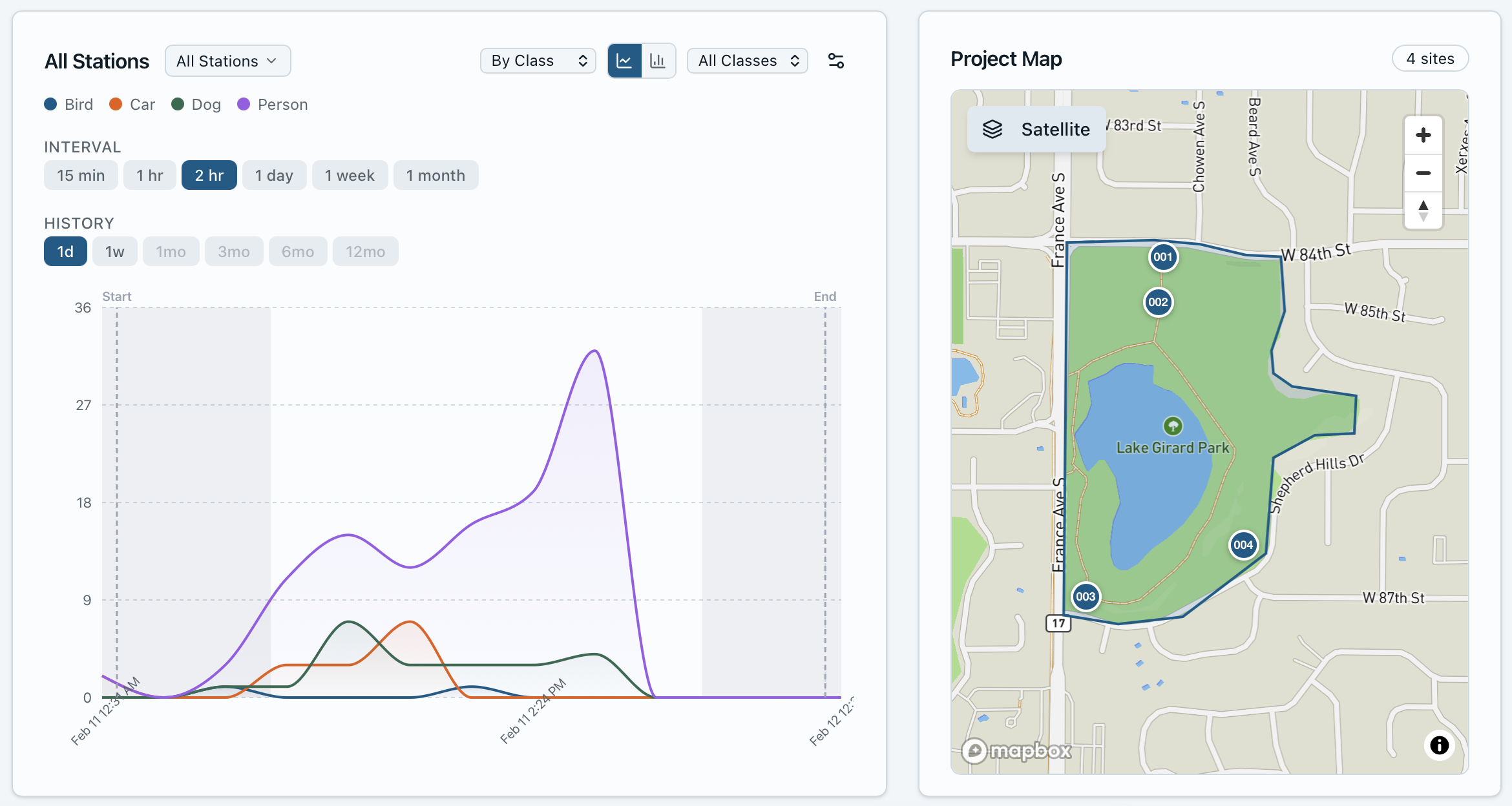
Waypoint Cloud
Explore every location from one dashboard
Observations are delivered automatically and appear in the Waypoint dashboard as they are processed — no SD cards, downloads, or site visits.
Privacy by Design
Analytics, not surveillance
VisionAI One exists to understand aggregate outdoor activity — not to identify individuals. Privacy is treated as a product requirement, not an afterthought.
Event-based stills, not video
The camera captures still images when activity is observed. It does not record continuous surveillance video.
Imagery serves the analytics
Images exist to support computer-vision analysis and data validation — access is limited to authorized users.
No facial recognition
Waypoint's models classify activity types. The system does not use facial recognition or identify specific individuals.
Deployment planning includes privacy
Camera placement, signage, and data handling are considered with each partner as part of deployment planning.
Read more about Waypoint's approach on the Privacy & Security page.
Who It's For
Built for the people responsible for outdoor spaces
VisionAI One is used by organizations that plan, manage, study, and fund outdoor recreation infrastructure:
- Parks & recreation departments
- Municipalities and counties
- State and regional park systems
- Trail organizations
- Land managers
- Universities and researchers
- Conservation organizations
- Outdoor recreation planners
Managing land where Waypoint deploys? Information for land partners.
Deployment
From a single study to a monitoring program
Pilot & Short-Term Studies
Evaluate data quality and fit with a focused visitor-use study before committing to a larger program.
Seasonal Monitoring
Capture a full season of usage data for planning, budgeting, grant applications, and reporting.
Before-and-After Studies
Establish a baseline, make an improvement, and measure how usage actually changed.
Long-Term & Multi-Site Programs
Monitor key locations continuously across a network, with every site in one dashboard.
See how deployments run in the field: Hyland Lake, Nine Mile Creek Bridge, and Lake Girard.
FAQ
Frequently asked questions
What is VisionAI One?
VisionAI One is a cellular, solar-capable outdoor monitoring camera built by Waypoint Telemetry. It captures event-based observations of activity in outdoor spaces — trails, parks, courts, trailheads, and parking areas — and Waypoint's cloud platform converts those observations into activity counts and utilization analytics.
How is VisionAI One different from a traditional trail counter?
Traditional counters register triggers and produce a number. VisionAI One measures activity visually, so it can classify activity types, determine direction of travel, support utilization analytics, and let authorized users review representative imagery behind the data. One device supports many applications beyond linear trail counting.
Does VisionAI One require Wi-Fi or utility power?
No. VisionAI One connects over cellular networks and runs on battery power, with external solar supporting long-duration deployments. No trenching, wiring, or local network infrastructure is required.
What types of activity can VisionAI One measure?
Depending on application and configuration, VisionAI One can measure pedestrians, cyclists, dogs, vehicles, and other supported activity types — along with direction of travel, time-of-day patterns, and overall activity mix.
Can VisionAI One measure pickleball or tennis court utilization?
Yes. Positioned to view a court area, VisionAI One measures when courts are occupied, how long they are used, and how demand changes by time of day and season — without manual observation studies.
Can VisionAI One monitor parking areas?
Yes. VisionAI One can observe parking areas at trailheads and recreation sites to help understand arrivals, occupancy patterns, and peak demand at access points.
How is imagery used?
VisionAI One captures event-based still images, not continuous video. Imagery exists to support computer-vision analysis and data validation. Waypoint's goal is understanding aggregate activity, not identifying individuals — the system does not use facial recognition, and privacy is a first-class consideration in deployment planning.
Can VisionAI One be used for temporary studies?
Yes. VisionAI One installs in minutes without permanent infrastructure, which makes it well suited to short-term visitor-use studies, seasonal monitoring, and before-and-after evaluations — as well as long-term monitoring programs.
How do I see the data?
Observations are delivered over cellular to Waypoint Cloud, where results appear in a web dashboard: trends over time, activity breakdowns, directionality, utilization, location comparisons, validation imagery, and exports.
How much does Waypoint cost?
Waypoint engagements typically start around $5,000. Short-term monitoring projects generally start at $5,000, and permanent monitoring is about $2,000 per device per year plus one-time device deployment starting at $1,000 per device, typically beginning with two locations. Volume pricing and multi-year agreements are available.
See full pricing guidanceWhat do you want to understand about your outdoor space?
Tell us what you're trying to measure. We'll help determine the right locations, deployment approach, and analytics configuration.
Or email directly: zach@waypointtelemetry.com