
Manufacturing and lab facility in Bloomington, Minnesota
VisionAI One, Waypoint's cellular AI camera for trails, parks, and courts, is designed, prototyped, assembled, and tested at our facility in Bloomington, Minnesota. This page shows what happens there and why building the product ourselves matters for the data it produces.
- Location
- Bloomington, Minnesota
- Metro
- Minneapolis–Saint Paul
- Functions
- Design, prototyping, assembly, test
- Staff on site
- 4-person engineering team
- Product
- VisionAI One
Why we build here
A Minnesota-made trail counter, built where it gets tested
A domestic manufacturer
Parks, transportation agencies, and municipalities that prefer or require U.S.-made equipment get a trail counter designed and built in Minnesota by the company that supports it.
The hardest test conditions are outside the door
Sub-zero temperatures, snow-covered solar panels, and short December days are the design constraints for a solar-capable outdoor camera. Our test sites see all of them a few miles from the lab.
One team from design to support
The engineers who lay out the board and print the enclosure also plan deployments and answer support questions. Field feedback goes straight back to the bench.
Nearby deployments include Hyland Lake Park Reserve with Three Rivers Park District and the Nine Mile Creek pedestrian bridge study with MnDOT, both a short drive from the lab.
Inside the lab
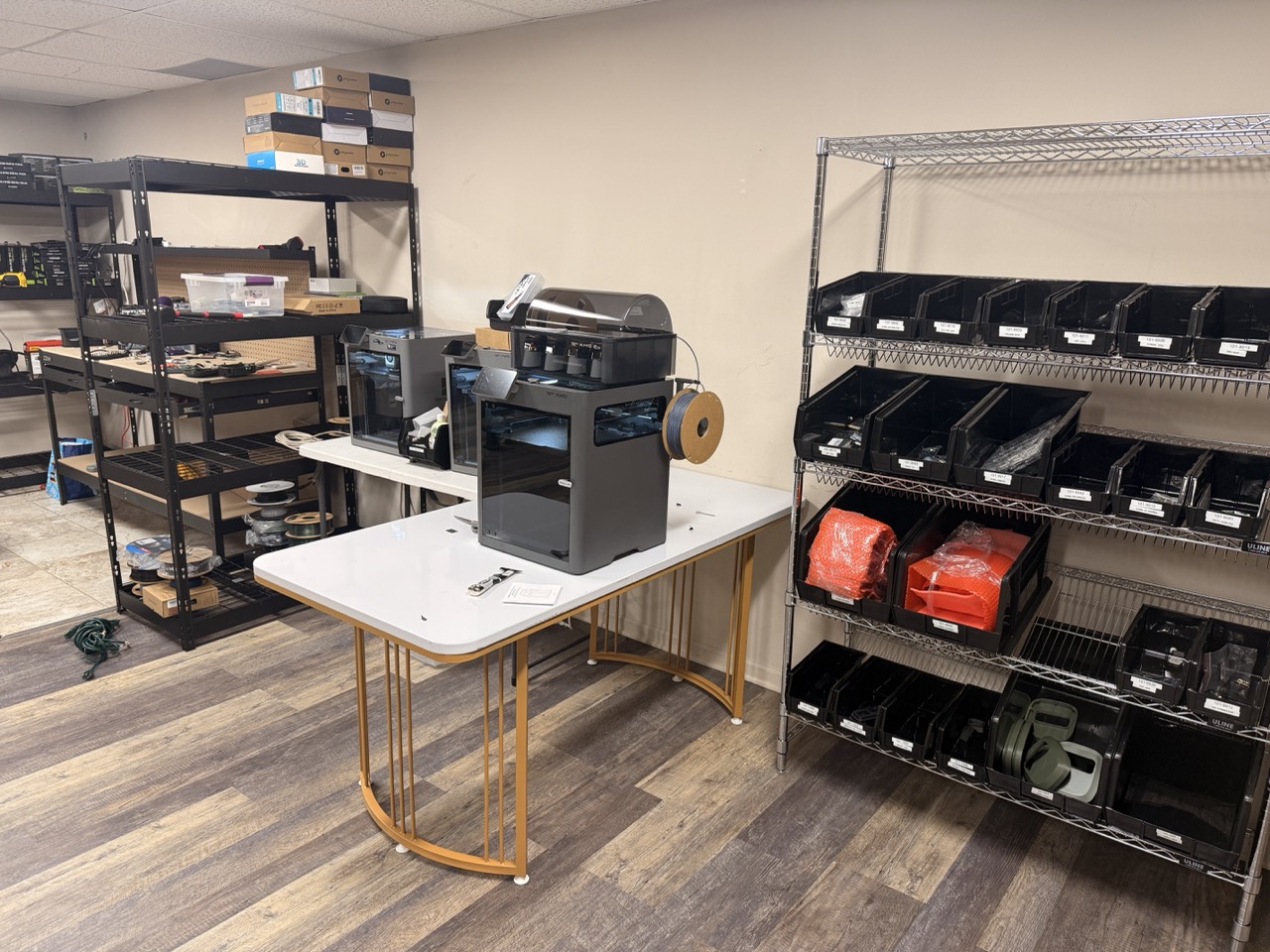
Prototyping, assembly, and inventory under one roof
Capabilities
| Capability | What we do | Where |
|---|---|---|
| Electronics design | Schematic capture and PCB layout of the VisionAI One main board, including cellular modem integration, battery management, and dual solar inputs. | In-house |
| Board bring-up and firmware | Power-on validation, sleep-current and charge profiling, camera and modem firmware development, and over-the-air update testing. | In-house |
| 3D printing and rapid prototyping | Enclosed multi-material 3D printers for enclosure revisions, camera and lens carriers, mounting brackets, jigs, and test fixtures. | In-house |
| Mechanical and enclosure design | Weather-sealed enclosure design, gasket and fastener selection, solar panel mounting, and tree, post, and pole mount hardware. | In-house |
| Environmental and durability testing | Weather-seal checks, cold-soak and thermal cycling on assembled units, and long-duration outdoor exposure at nearby test sites. | In-house |
| Solar and battery endurance testing | Multi-week power-budget runs across seasonal light conditions, including partial and full panel shading. | In-house |
| Cellular and RF validation | Antenna tuning, enclosure RF performance, and carrier certification support in partnership with F3 Wireless of Minneapolis. | With F3 Wireless |
| Final assembly and quality inspection | Unit assembly, functional test, cellular connection check, and inspection of every camera before it is kitted for shipment. | In-house |
| Inventory and deployment kitting | Labeled component inventory and staging of cameras, solar panels, and mounting kits for each customer deployment. | In-house |
Design to deployment
How a VisionAI One revision moves through the building
- 01
Design
Board layout, enclosure geometry, and firmware architecture are developed together so the electronics, mechanical parts, and power budget are designed as one system.
- 02
Prototype
Enclosure and mount revisions are 3D printed in-house and fit-checked against real boards the same day, so mechanical and electrical changes iterate in step.
- 03
Build
Boards are brought up on the bench, loaded with firmware, and assembled into sealed engineering samples that match what ships to customers.
- 04
Test
Every revision is cycled through weather-seal, power, and cellular checks. Units then run at outdoor test sites through the same seasons customers deploy in.
- 05
Deploy and support
Kitted systems ship from Bloomington with mounting hardware and a coverage plan. Field data and support questions come back to the same team.
Our own electronics
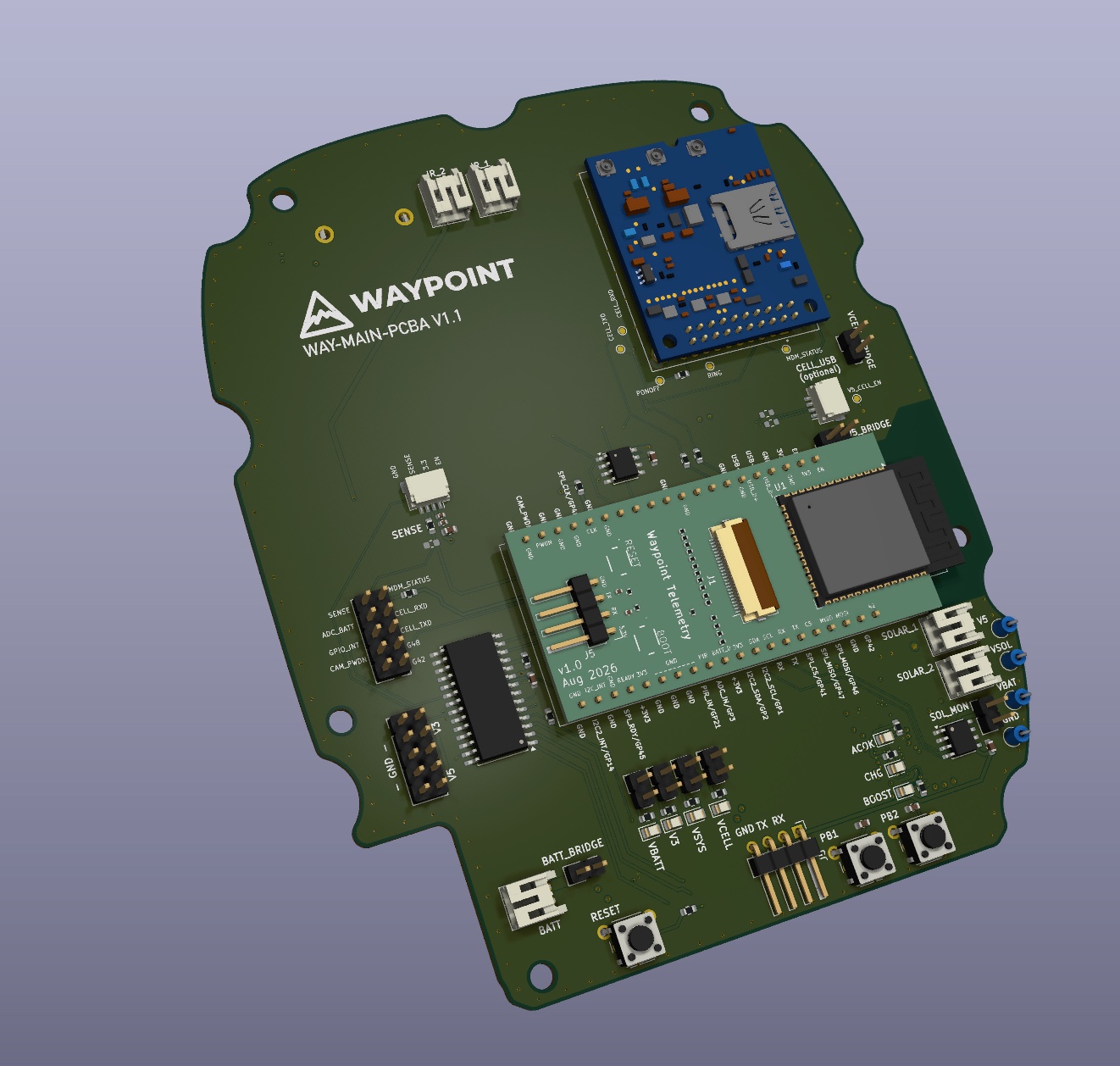
The VisionAI One main board is a Waypoint design. It integrates the cellular modem, camera processing module, battery management, and dual solar inputs on one assembly, and it is revised in numbered versions as field data comes back from deployments.
Designing the board in-house is what makes the power budget trustworthy. Sleep current, charge behavior, and modem duty cycle are measured on our bench rather than assumed from a datasheet. See how that translates to autonomous operation through winter.
3D printing and rapid prototyping
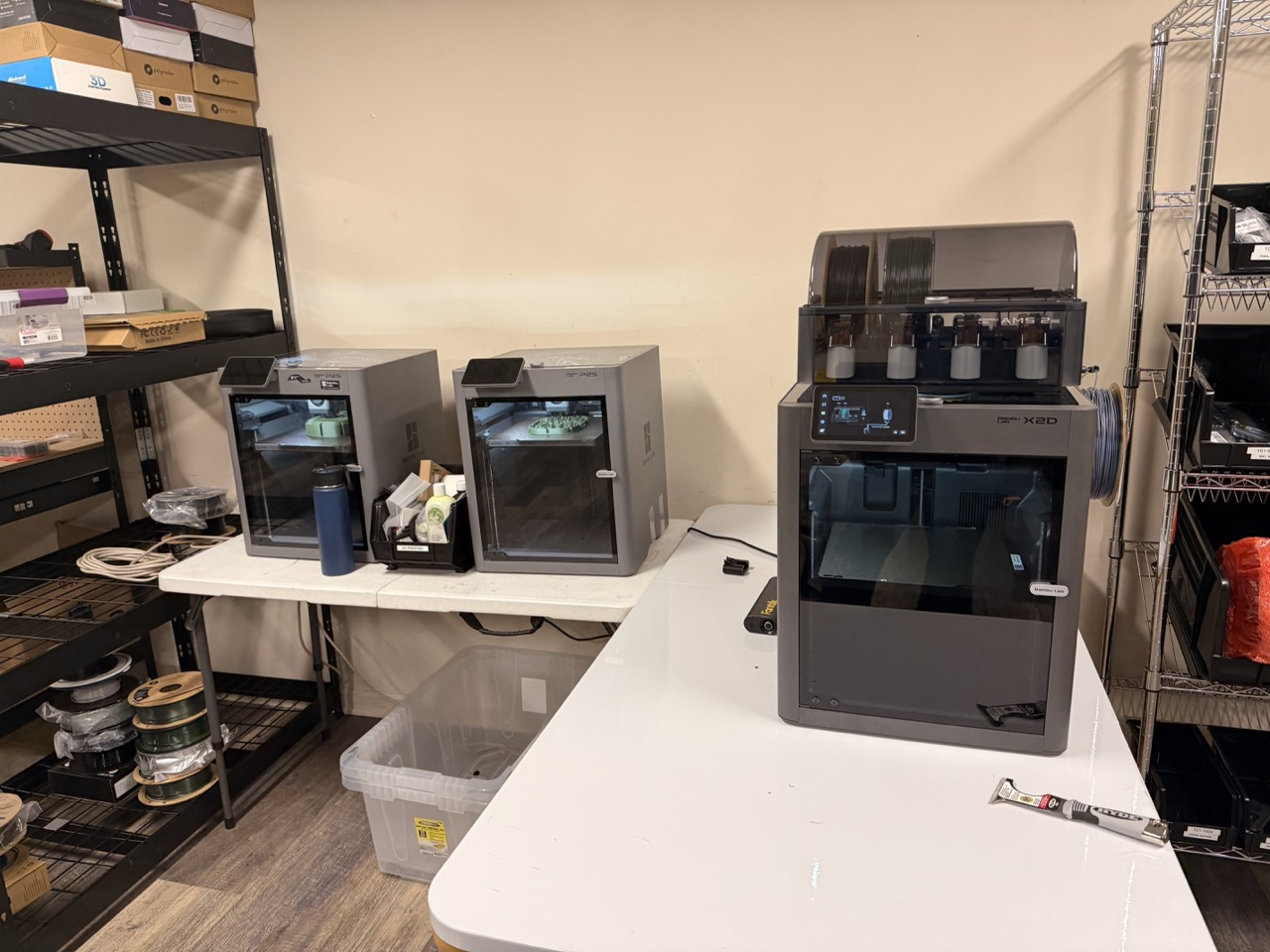
A bank of enclosed, multi-material 3D printers sits beside the electronics bench. Enclosure revisions, camera carriers, mounting brackets, jigs, and test fixtures are printed and fit-checked against real boards in hours instead of waiting on an outside shop.
The tree straps, pole mounts, and extension arms documented in the deployment guide were prototyped here and proven at nearby trail sites before becoming standard kit.
Engineering samples before every release
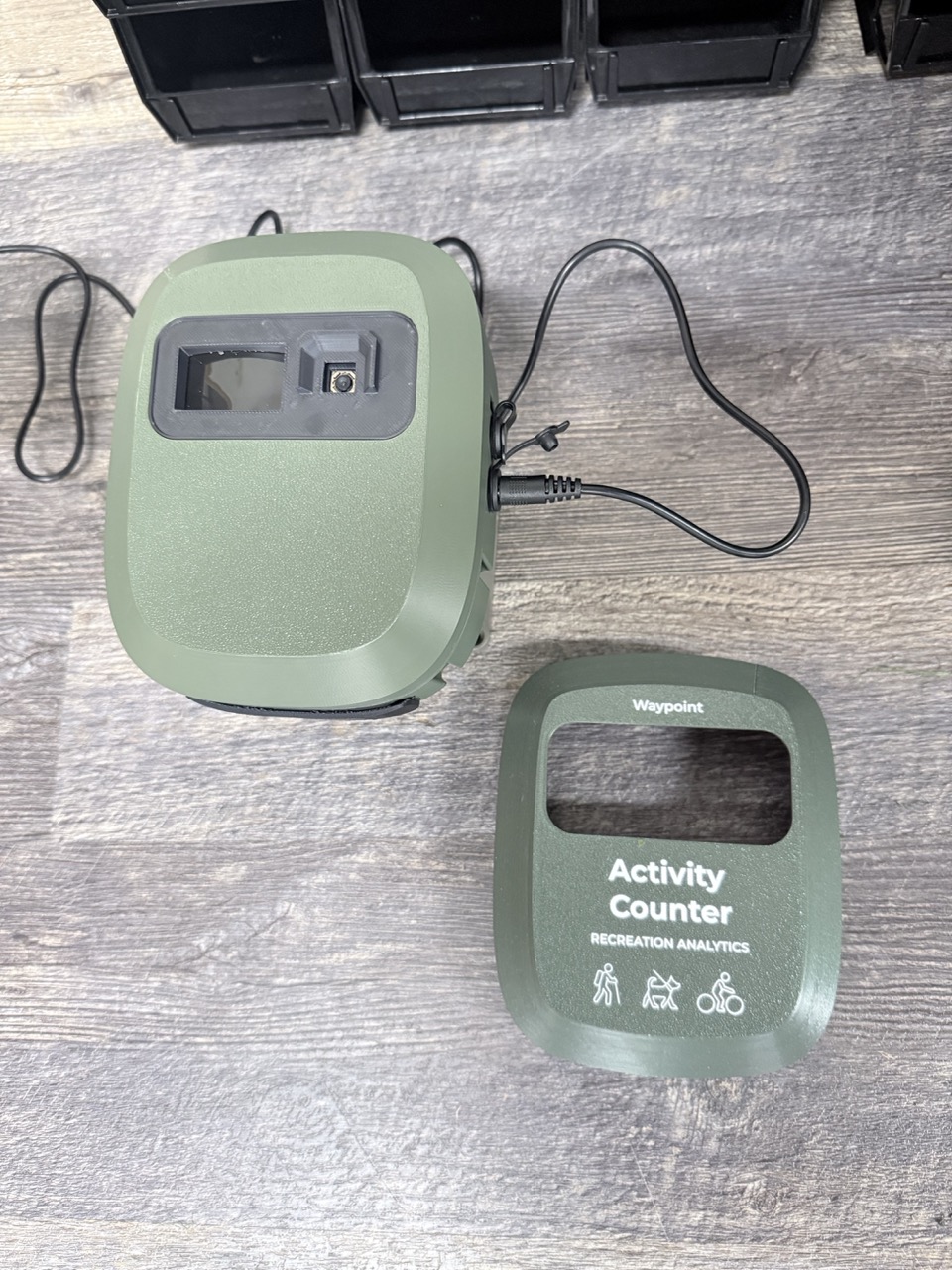
Each design change becomes a physical engineering sample on this floor: enclosure body, camera window, and the labeled front bezel that identifies the unit as a Waypoint activity counter. Samples are sealed, powered, and cycled before a revision is approved for deployment.
The visible labeling is deliberate. VisionAI One is non-covert by design, which is central to our privacy and transparency approach. The finished product is on the VisionAI One page.
Cellular validation with F3 Wireless
Every Waypoint product is cellular, so radio performance inside a sealed enclosure is validated with F3 Wireless, a Minneapolis wireless engineering firm specializing in cellular and IoT device design, custom antennas, and carrier certification. Antenna tuning and over-the-air testing happen there; final connectivity checks on every unit happen in Bloomington. More on the partnership and the team on the About page.
- RF design review of the main board
- Antenna tuning inside the enclosure
- Carrier certification support
- Per-unit cellular check before shipment
Memberships
Part of the parks and outdoor recreation profession
Waypoint is an active member of the national and Minnesota associations that serve the agencies our cameras are built for.


Visit, or bring a site to the team
Agencies and partners in the Twin Cities are welcome to see the lab and handle the hardware. Anyone else can send a site and get a coverage and mounting assessment from the engineers who build it.