
Waypoint Research · Validation Report
Validating Computer Vision for Tennis & Pickleball Court Utilization
Published October 2026 · Waypoint Telemetry Engineering
Waypoint tested whether a single VisionAI One with a 120° wide-angle lens can reliably determine whether, when, and how tennis and pickleball courts are being used — across the near court, the far court, and the edges of the frame.
- Study type
- Field validation
- Application
- Tennis and pickleball courts
- Hardware
- VisionAI One, 120° wide-angle lens
- Environment
- Outdoor public courts
- Frames analyzed
- 76 full-resolution frames (1600 × 1200)
- Objective
- Validate whether one sensor can measure utilization across two adjacent courts
01 — Research Question
Research question
Court utilization is a different measurement problem from trail counting. The question is not whether someone crossed a line, but whether a remotely mounted sensor can reliably tell what is happening across a large playing area: is the court occupied, how many players are on it, and does that hold true at the far baseline as well as the near one?
This study asked: can one VisionAI One, mounted at the side of a court complex, detect players reliably across two adjacent tennis or pickleball courts?
02 — Methodology
Methodology
A VisionAI One fitted with a 120° wide-angle lens was mounted at the end of the net line between two adjacent courts, at both a two-court tennis site and a two-court pickleball site. A test subject moved through the near court, the far court, the baselines, and the frame edges while the camera captured frames in direct afternoon sun.
Every frame was processed through Waypoint's production vision pipeline, and each detection was inspected against its overlay to confirm where players were found, where confidence dropped, and how the wide-angle lens rendered the far side of the complex.
- Near court and far court
- Service line, baseline, and net positions
- Center and edges of the 120° field of view
- Tennis and pickleball court layouts
- Bright sun with hard shadows
03 — Test Setup
Test setup
One sensor, one wide field of view. Mounting the camera on the net line between two courts puts both playing areas inside a single 120° view, with the near court on one side of the frame and the far court on the other.
Wide-angle lenses bend straight lines toward the edges of the frame, which is visible in the curved court lines of the example images. Because the detection model was evaluated on these frames directly, the barrel distortion at the edges did not prevent players from being detected.
04 — Results
Results
>95%
Player detection
Players within 100 ft of the camera
2
Courts per sensor
Two tennis or two pickleball courts
120°
Field of view
Covers both courts from the net line
100 ft
Validated range
Near baseline to far baseline
What we found
Can Waypoint reliably determine whether a court is occupied? Yes. Players were detected on both courts across the 100 ft range, which is enough to record occupancy by hour for each court independently.
Does performance hold at the far side? Players at the far court and far baseline were detected, with detection confidence highest on the near court and lower — but still above the counting threshold — on the far court.
Can one camera cover the area? A single sensor on the net line covered two adjacent tennis courts or two adjacent pickleball courts. Larger complexes need one sensor for each pair of courts.
05 — Example Observations
What the sensor sees
Unedited frames from the test set with the pipeline's detections overlaid — the actual input, and what the system concluded. Faces are pixelated for privacy.
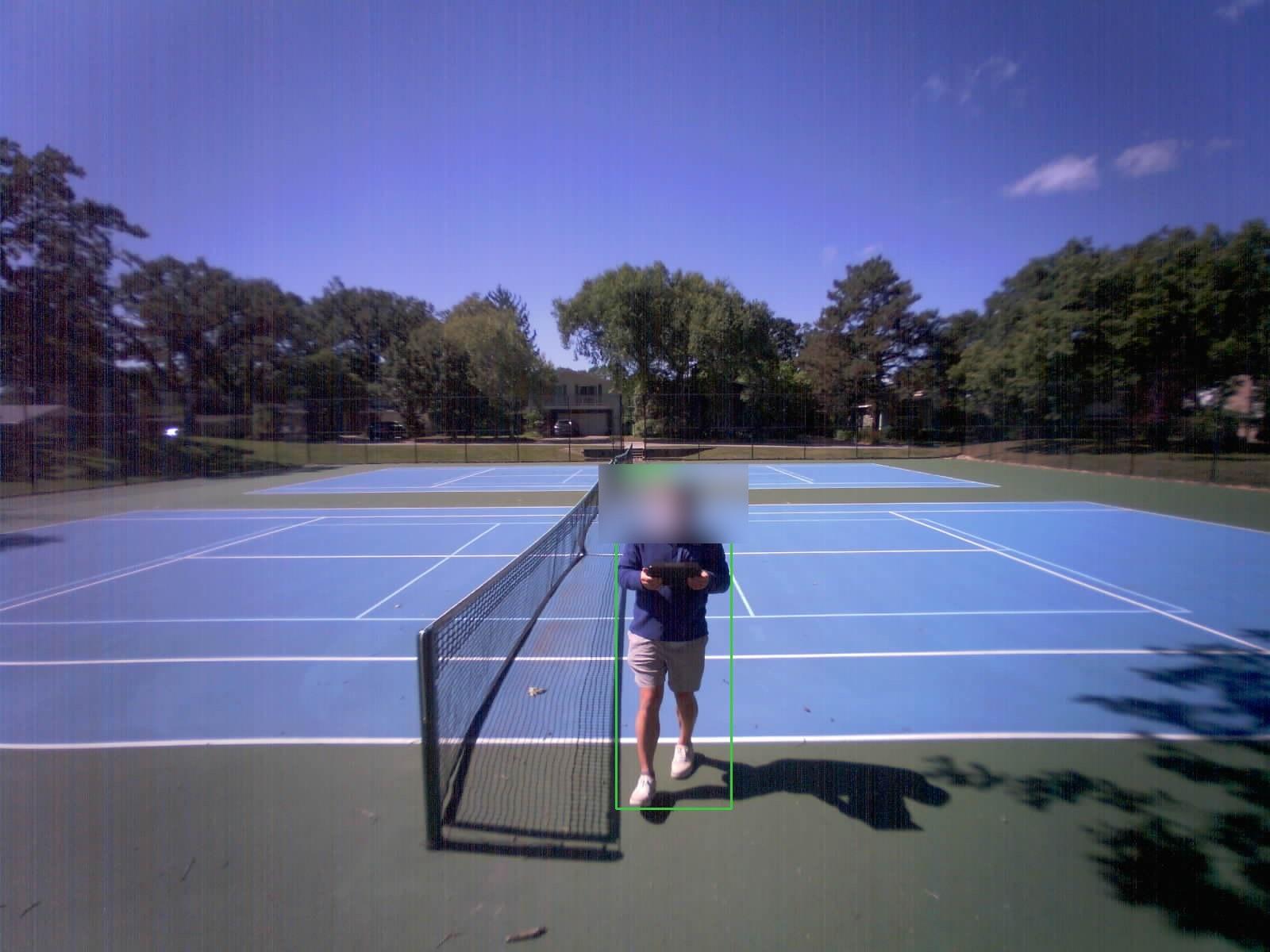
Tennis, near court
Player detected at the net, confidence 0.89
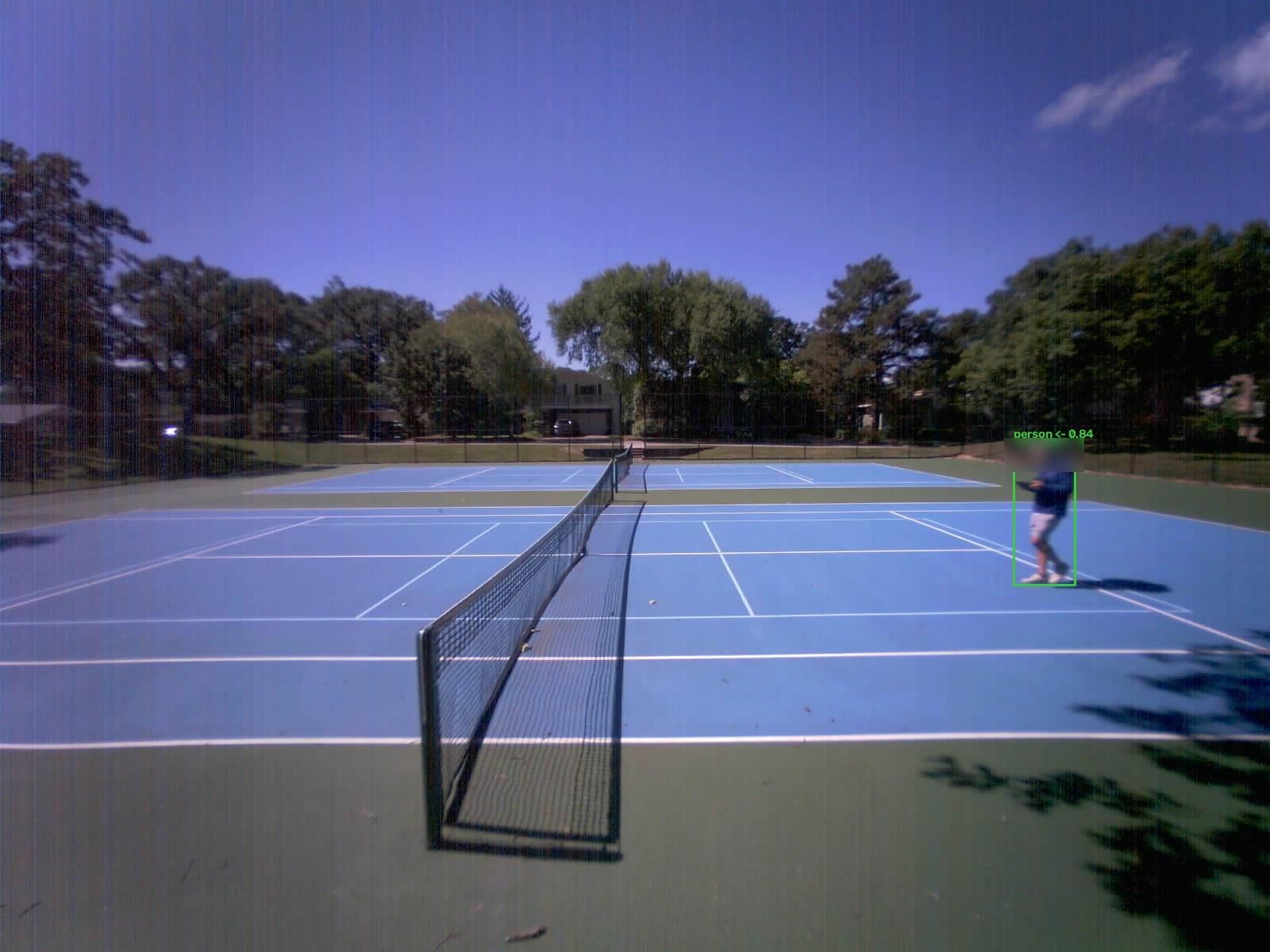
Tennis, edge of the field of view
Player detected near the frame edge, confidence 0.84
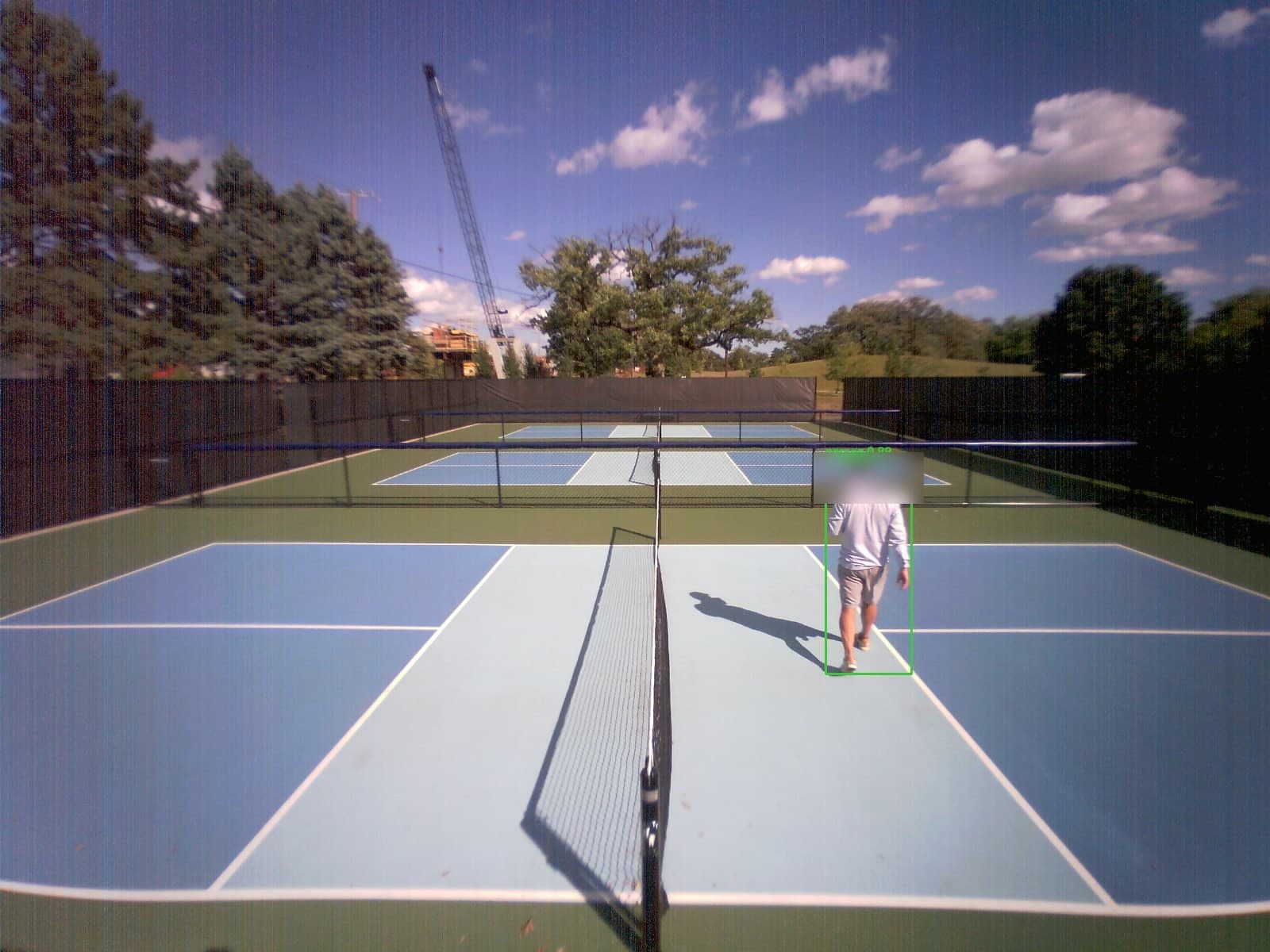
Pickleball, two courts in one view
Player detected mid-court, both courts in frame
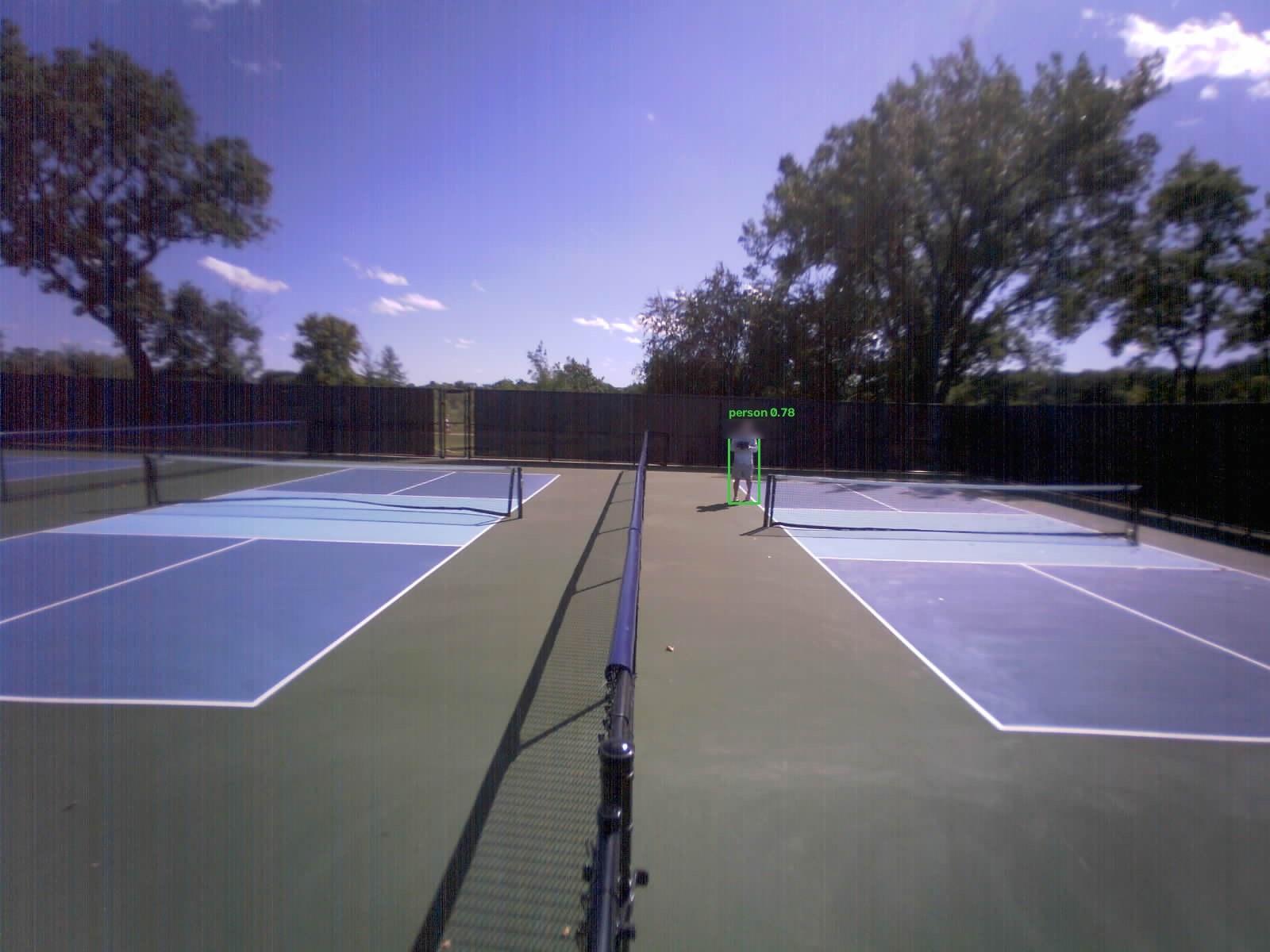
Pickleball, far baseline
Distant player detected at the far baseline, confidence 0.78
06 — Limitations
Where performance declined
Detection confidence decreased with distance, and players beyond the far baseline of the second court — for example, on a third court further away — appeared too small to be counted reliably. That is the practical limit behind the two-courts-per-sensor guideline.
Barrel distortion compresses subjects at the extreme edges of the frame. Players remained detectable there, but placement should keep the playing areas inside the central portion of the view where possible.
07 — Deployment Recommendations
From validation to installation guidelines
- Camera placement
- Mount at the end of the net line between two courts so both playing areas sit inside the 120° view.
- Coverage
- Plan one sensor for each pair of tennis or pickleball courts. Larger complexes use multiple sensors reporting into one project.
- Viewing distance
- Keep the far baseline within 100 ft of the camera.
- Lens selection
- Use the 120° wide-angle lens; a narrower lens cannot see both courts from a single mount point.
- Mounting height
- Mount above the fence line where possible so the net and windscreens do not block the far court.
- Sun angle
- Prefer a mount that does not look directly into the afternoon sun, which lowers confidence at the far court.
Need defensible usage data?
See how these results translate into a deployment, or talk with our team about your site.